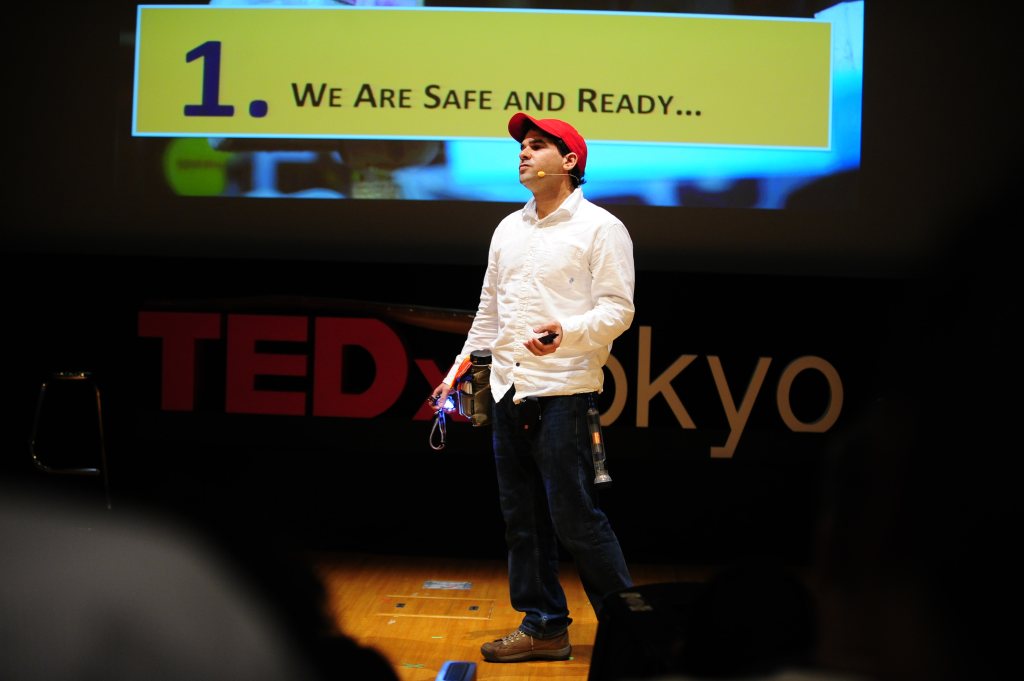
Chief Innovation Officer & Director of Transformation
Carlos
Miranda Levy
Artificial Intelligence • Disruptive Innovation • Effective Learning • Social Impact • Human Development
Photo: Andy McGovern / TEDxTokyo
About
Who I Am
I am rational and structured in my thinking. My instinct is to deconstruct, build frameworks, construct models, and work systematically from them. But this structure serves as a launchpad, not a cage — my approach is deeply creative, innovative, and deliberately unconventional. I believe fundamentally in collaboration and participation as design principles. My worldview is anchored in shared prosperity — the conviction that doing well and doing good are reinforcing objectives. I am a firm believer in free markets and neo-liberal economics, favoring minimal government intervention.
I have lived across four continents — Menlo Park, New York, Singapore, Paris, Port of Spain, Santiago, Tokyo, and Santo Domingo where I currently reside. Born in 1971, this geographic range is formative — it shapes how I read markets, cultures, institutions, and people. I speak fluent Spanish, English, French, and Portuguese; languages acquired through immersion in the places where they are lived.
I am the father of a young man born in 2012. I pursued shared custody with determination, achieving an arrangement where my son is with me half of the days of each month. We share a close, active relationship built on honesty, trust, and genuine enjoyment of each other’s company — audiobooks, video games, biking, open-water swimming, films, and anime. We also share our home with Snoopy, a white boxer with a brown patch on her left eye.
I maintain a consistent physical discipline: running three days a week, swimming twice a week, and biking to work. For me, physical activity is not a wellness trend but a structural part of how I think and operate.
Fellowship
Stanford University
Reuters Digital Vision Fellow — Innovation, entrepreneurship, and social impact at one of the world's leading innovation and education institutions.
Residency
National University of Singapore
Social Entrepreneur in Residence — Developing sustainable models for social innovation across Asia.
Philosophy
NEVER HELP
Engage, Enable, Inspire, Empower and Connect
The word “help” implies asymmetry — someone who knows better providing solutions to someone who doesn’t. That assumption is the starting point of dependency, not development. My mantra rejects it deliberately and proposes a five-stage alternative, where each stage builds on the previous one:
Engage
Meet stakeholders where they are. They must be part of understanding their own situation before any solution is designed. No one should diagnose or prescribe on behalf of others without their active participation in the process.
Enable
Provide knowledge, skills, and tools — never finished solutions. The goal is to build capability, not to create dependency. Nothing should be given without requesting something in return, because exchange creates ownership and commitment.
Inspire
Show possibilities and opportunities that expand what stakeholders believe they can achieve. Aspiration is not imposed; it is awakened by exposure to what is possible.
Empower
Shift ownership entirely. Stakeholders build their own path. The role of the enabler is to provide scaffolding — frameworks, resources, access — not to construct the building.
Connect
Link stakeholders to others, to networks, and to the world, so their growth never depends on a single point of failure. Synergies and networks multiply what any individual or organization can achieve alone, and ensure sustainability beyond any single relationship.
This philosophy applies universally across my work — in education, business transformation, social entrepreneurship, technology adoption, and personal relationships. It is not a methodology for specific projects; it is a worldview about how human potential is unlocked.
Recognition
Global Impact, Recognized Worldwide
Honored by leading institutions for contributions to technology, innovation, and social entrepreneurship.
CNN
"20 Latin American Leaders of the Internet"
MIT
"Emerging Leader, Scholar and Entrepreneur"
Forbes
"30 Business Promises"
"Developing World Scholarship"
Stanford
"Digital Vision Fellow"
Supported By
Grants and scholarships from leading global foundations
The Journey
From a TI-99 to Four Continents
My relationship with technology began in 1981, at age 10, with a Texas Instruments TI-99/4A home computer and a first-generation IBM PC — machines that turned early curiosity into a lifelong conviction about technology’s power to transform. By 1996, that conviction led to founding CIVILA (Ciudades Virtuales Latinas), one of the earliest social networks in Latin America — built years before Friendster, MySpace, or Facebook existed. In 2000, CNN recognized me as one of the 20 most influential leaders of the Internet in Latin America.
I studied Economics and have since built a career at the crossroads of innovation, education, social entrepreneurship, technology, and human development. My work has spanned international organizations, universities, governments, social organizations, and private companies across four continents — from Silicon Valley to Singapore, from Paris to Port of Spain, from Santiago to Santo Domingo.
My trajectory is marked by a consistent pattern: identifying moments where technology, human potential, and systemic change intersect, and building frameworks, projects, and organizations at those intersections. Whether working on disaster relief technology, educational platforms reaching millions, or business transformation strategies, the through-line is always the same — using innovation to create conditions where people and organizations can transcend their circumstances.
Roles & Experience
Innovation
Models & Frameworks
I create replicable frameworks rather than one-off projects — systematizing innovation into models and methodologies that others can adopt, adapt, and scale. These frameworks are developed through CEMI.ai (Collectively Enhanced Multiple Intelligence), a collective built around the principle that human-AI collaboration produces outcomes neither humans nor AI can achieve alone.
Social Innovation
SIFT
Social Impact with Technology — A framework for creating technology solutions that drive meaningful social change while remaining sustainable and scalable. SIFT provides a structured approach to identifying social challenges, designing tech-powered interventions, and measuring real-world impact.
Education Technology
Smoother
Personalized Learning Experiences — Adaptive, personalized learning paths that meet each learner where they are. Smoother leverages technology to create smooth educational journeys that respect individual pace, style, and goals, resulting in deeper engagement and more effective learning outcomes.
Media & AI
MediaMax
Dynamic Media Creation — A revolutionary approach combining human creativity with AI capabilities for cinematic results. A team of 30+ specialized AI agents trained on hundreds of aspects and parameters — from the most specific details of media production to holistic vision, artistic vibe, and production approaches — transforms the pipeline, enabling high-quality, culturally-relevant content without sacrificing creative integrity.
Professional Development
Humania & Competencia
Professional Skills Enhancement — An AI-powered platform for developing essential human skills in the age of automation. Humania focuses on the irreplaceable human capabilities — empathy, creativity, leadership, critical thinking — that become more valuable as technology advances.
Web Design & AI
SiteCraft
AI-Assisted Web Design — A comprehensive framework that defines the soul of a website before touching its skin. SiteCraft orchestrates 11 specialized AI agents to guide design, tone, structure, and every component — delivering clarity, purpose, and creative direction for each project.
Music & AI
MaiMusic
Multidisciplinary Music Production — A team of 23 specialist AI agents — 13 production and 10 advisory — delivering precise, evocative musical productions with fine-grained compositional control, from single pieces to comprehensive audio branding systems.
Views
Perspectives on Innovation, Technology & Society
Change is inevitable and disruption, when it arrives, is transcendental — not incremental. It does not merely alter products or processes; it reshapes relationships, redefines stakeholders, restructures operations, and transforms entire ecosystems.
This disruption creates a fundamental asymmetry. Stakeholders who recognize and respond to change early gain disproportionate opportunities to grow, lead, and define the new landscape. Those who wait face the risk of irrelevance or extinction. And for new entrants — unburdened by legacy structures and assumptions — disruption opens doors that previously did not exist.
The critical insight is temporal. Change is already happening. Its velocity is high, even if its visible impact arrives unevenly across sectors and geographies. The only losing strategy is to wait for disruption to become obvious before responding — because by then, competitors, markets, and even entirely new players will have already adapted. Right now, while some are still deliberating whether and how to adapt, others are already doing it. The time to transform is before transformation feels urgent.
This view is deeply informed by two frameworks I consider essential: Clayton Christensen’s Innovator’s Dilemma — which explains how successful incumbents fail precisely because they optimize for the present at the expense of the future — and Joseph Schumpeter’s Creative Destruction — which holds that economic progress is driven not by incremental improvement but by the constant dismantling and replacement of existing structures by new ones.
The most powerful technology is the one that creates opportunities and empowers people and organizations to transcend their circumstances — with dignity, inclusion, and the capacity to generate net positive value and impact. But technology only creates the conditions; the outcome belongs to the people and organizations who act on them.
This is not a tagline. It is the filter through which I evaluate every technology, every platform, every innovation. Technology that concentrates power, excludes populations, or strips dignity fails this test — regardless of its technical sophistication. Technology that expands what people and organizations can think, create, build, and become — while respecting who they are and where they come from — passes it.
This principle connects directly to my philosophy on AI, my spiritual view on technology, and my approach to every project I build.
The conversation around Artificial Intelligence too often centers on replacement — which jobs will disappear, which tasks machines will take over. I consider that framing fundamentally misguided.
The true power of AI is not about replacing humans. It is about augmenting human capabilities — expanding what people can think, create, build, and achieve. The pivotal shift happens when the question changes from “What can AI do instead of me?” to “What can I do with AI that I never could before?”
This reframing reveals a trap that most adopters fall into: using AI to do the same things they have always done, just faster and easier. That approach captures none of AI’s real potential. It delivers the same outcomes with less effort — arriving at the same level as before, at the same level as everyone else who adopts the same tools the same way.
The exponential advantage lies elsewhere. Because AI makes existing tasks faster and easier, that freed capacity should be redirected — toward doing those things better, toward doing more things, toward doing entirely new things that were previously impossible. The efficiency gain is not the destination; it is the launchpad. Those who understand this distinction will leapfrog those who don’t.
There is an additional dimension that I consider particularly important for emerging markets and non-dominant cultures. AI’s training data is biased and limited — it does not yet fully understand local markets, particular cultures, specific realities and conditions. Rather than a limitation, this is an opportunity. Those who apply AI within their own cultural context — at the rhythm of their own heritage — will produce results that generic AI adoption cannot match. As I usually say: “What makes us different, makes us better.”
I hold a position on intellectual property that is philosophically grounded and deliberately expansive: all knowledge and content is patrimony of humanity. New knowledge is built on previous knowledge. Every human learns by reading, accessing, absorbing, and building on what others have created. Even before language existed, knowledge was transmitted through imitation and social learning. Every religious tradition, every philosophical system, every scientific breakthrough, even the information encoded in our genes — all derive from previous knowledge.
From this premise, I assert that all humans have an undeniable universal right of access to content — provided that creators’ rights, attribution, and the possibility of fair compensation for their efforts are respected and protected. Access to knowledge should not be unilaterally restricted by any party.
The spirit of copyright law and intellectual property is not to restrict access to content and knowledge but to incentivize and promote the creation of new content and knowledge. This is a critical distinction: protection as a means to encourage creation, not as an end that limits access.
The true challenge and opportunity around AI and intellectual property is not about preventing access. It is about two things simultaneously: first, guaranteeing that incentives for knowledge creation remain robust and meaningful; and second, ensuring that access to knowledge and content does not lead to mere replication, plagiarism, or summarization — but instead fuels an explosion of creation, creativity, and new knowledge that builds exponentially on what came before.
Humanity has always aspired to transcend the physical. Across cultures and millennia, we have dreamed of omnipresence and omniscience — imagined beings who exist in multiple places simultaneously, who communicate across impossible distances, who access knowledge beyond individual experience. We have built entire metaphysical architectures around this aspiration: gods, spirits, moral frameworks, philosophical systems, religious traditions.
Beyond transcendence, humanity has consistently idealized non-carnal, non-physical forms of connection — with others and with one’s own essence. Across traditions, the highest forms of love, understanding, and communion have been described as spiritual rather than physical: connections of mind, soul, and meaning that transcend the body.
Technology makes those ancient aspirations tangible. It allows interaction with anyone, anywhere, anytime. It provides access to the accumulated knowledge of humanity. It enables connections in intellectual and emotional dimensions as authentic and meaningful as any physical encounter. What mystics imagined and theologians described, engineers have built — not as metaphor, but as lived experience available to billions.
The liberation runs deeper still. Technology does not only connect — it frees. It removes the mechanical burdens that have consumed human time and energy for centuries. When those burdens lift, what remains is the essentially human — creativity, empathy, judgment, meaning, connection.
This is the spiritual promise of technology: not the replacement of humanity, but the creation of space to inhabit it fully. Freed from the mechanical, humans can focus on the creative, the compassionate, the visionary — on what truly makes each person unique. Technology, understood this way, is not a departure from the spiritual dimension of existence but its most powerful enabler.
AI Projects
AI in Action
Projects from CEMI.ai, exploring the creative and practical frontiers of human-AI collaboration.

MaiMusic
AI music artists and bands — original compositions produced entirely by specialized AI agents, from songwriting to final master.

100+ Things to Do with AI
A practical, ever-growing guide to real-world AI applications — from creative projects to business automation and beyond.
Lawra
Your independent guide to AI in legal practice — practical, ethical, and multilingual.
Insureversia
An independent guide to AI in insurance — practical resources on underwriting, claims, risk, and compliance.

iBizAI - Intelligent Business with AI
A platform helping business professionals understand and responsibly adopt AI across industries.
Just for Fun
Fun Side Projects
Interactive experiences built for curiosity, learning, and pure enjoyment.


Thought Leadership
Talks & Presentations
Sharing ideas on innovation, technology, and social impact on global stages.

MediaMax
AI-assisted video creation model — combining human creativity with artificial intelligence for cinematic results.
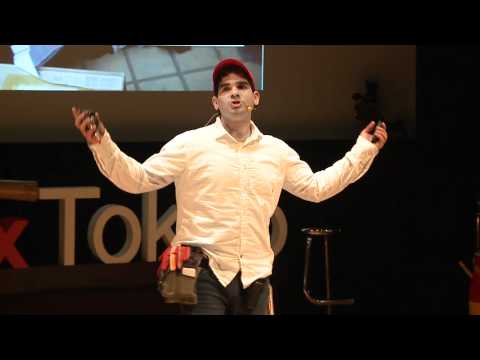
TEDxTokyo
Innovation, technology, and social impact on the global stage — crisis management and transcending devastation with dignity.
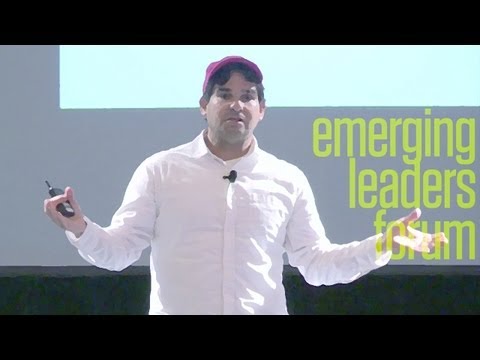
MIT Emerging Leaders
Entrepreneurship and emerging leadership in technology — recognized as one of six emerging leaders, scholars and entrepreneurs.
Art & Culture
Books, Films & Aesthetic Sensibility
My aesthetic sensibility gravitates toward work that explores how individuals and civilizations navigate forces larger than themselves — systems, institutions, time, entropy, absurdity — while retaining agency, dignity, or at least a sense of humor about the whole endeavor.
Favorite Books & Authors
Favorite Films & Filmmakers
Gallery
In the Field & In the Studio
From disaster relief zones to TEDx stages — a visual journey across continents.
Connect
Let's Build Something Together
Whether you're looking to innovate, collaborate, or transform — let's connect.
Social Media
Transform your vision with our innovative approach